
Do you know what air you're breathing? Discover the effects of polluted air on your health!
Back to blogThe air quality has significantly worsened in recent years, especially in large cities, where car traffic, old heating plants, and landfills play a significant role. Air pollution is closely linked to general health, and can lead to the development of quite serious conditions. People living in areas with high traffic are at a greater risk of developing cancer, heart disease, or respiratory illnesses (bronchitis, asthma, allergies) because more crowded areas have a higher degree of pollution. Statistics even show that air pollution claims more lives than malaria and HIV combined. In terms of pollution levels, the capital city of Bucharest is considered the most polluted European capital.
Polluted air has negative effects on everyone, but children, the elderly, and pregnant women are the most exposed. Children younger than 15 inhale more air, and consequently, more pollutants. They breathe faster than adults and tend to inhale more air through their mouths, thus bypassing the natural filter in the nose. Additionally, they are more susceptible because their lungs are not sufficiently developed.
It is worrying that the EU program – „Clean Air For Europe (CAFE)”– he estimated a total of 348,000 premature deaths per year caused by exposure to fine particulate matter (PM2.5), according to the data provided by eea.europa.eu.
The air also contains very small amounts of other gases, known as residual gases, including carbon dioxide and methane.
In addition, there are thousands of other gases and particles (including soot and metals) emitted into the atmosphere by both natural and anthropogenic sources.„, according to eea.europa.eu.
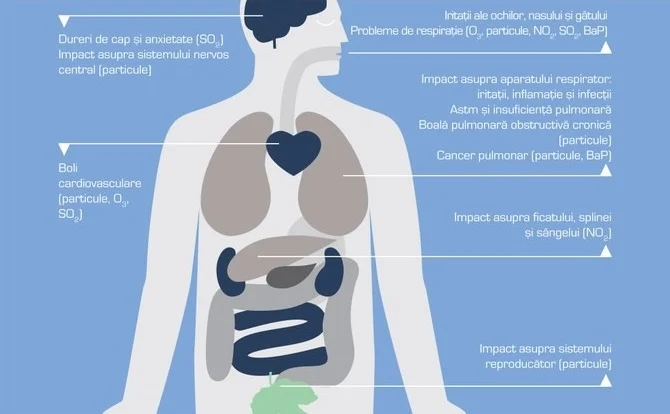
WHO (World Health Organization) He/She created a ranking that includes the short-term and long-term effects of air pollutants on the body. Main atmospheric pollutants Nitrogen oxides, sulfur dioxide, tropospheric ozone, carbon monoxide, formaldehyde, phenols, particulate matter (PM10 and 2.5 µm).
PM – fine particulate
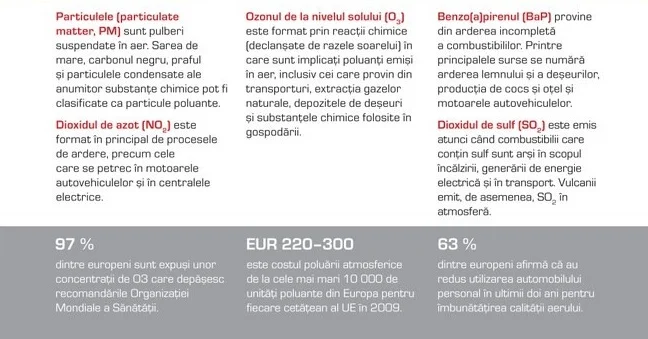
Particles are the pollutant that affects human health the most. They are powders suspended in the air. For example, sea salt, black carbon, dust, and condensed particles of certain chemicals can be classified as polluting particles. Furthermore, particles can also contain some heavy metals, such as arsenic, cadmium, mercury, and nickel.
Inhaling these particles can lead to the development of several conditions, such as asthma, infections, inflammation, lung failure, and chronic obstructive pulmonary disease. People may experience repeated coughing fits, chest pain, and difficulty breathing.
CO
Carbon monoxide results from the combustion of fossil fuels, such as vehicle engines, thermal power plants, and cigarettes. At relatively low concentrations, it affects the central nervous system, weakens the heart's pulse, reduces visual acuity and physical capacity, can cause respiratory difficulties, chest pain in people with cardiovascular disease, irritability, migraines, lack of coordination, nausea, dizziness, confusion, fatigue, and reduced concentration.
NO2
Nitrogen dioxide is a reddish-brown gas with a strong, pungent odor. It is primarily a result of combustion processes, such as those occurring in vehicle engines and power plants.
Exposure to high concentrations can be fatal, and at low concentrations, it affects lung tissue. People exposed to this type of pollutant may experience respiratory irritation and lung dysfunction. Long-term exposure to nitrogen dioxide can affect the liver, spleen, and blood quality.
SO2
SO2, also known as sulfur dioxide, is another type of pollutant that has negative health effects. It is a colorless, bitter, non-flammable gas with a pungent odor that irritates the eyes and respiratory tract.
Gas is released when fuels containing sulfur are burned for heating, electricity generation, and transportation. Volcanoes also release SO2 into the air.
Inhaling sulfur dioxide can have numerous consequences for the respiratory system and can cause headaches and anxiety. Furthermore, it can even affect the nervous system.
Air pollution maps don't rank Bucharest very highly. But there's a special place in the Capital where you can connect with nature and enjoy clean air – in the residential neighborhood embraced by the forest, Greenfield Băneasa.
In Greenfield, the air is cleaner than in downtown Bucharest, thanks to the 900 hectares of forest surrounding the complex. Levels are checked by an air quality monitoring station that compares indicators from Greenfield with those recorded in the city center. We'll be back soon with more details on how you can check the air quality you're breathing.